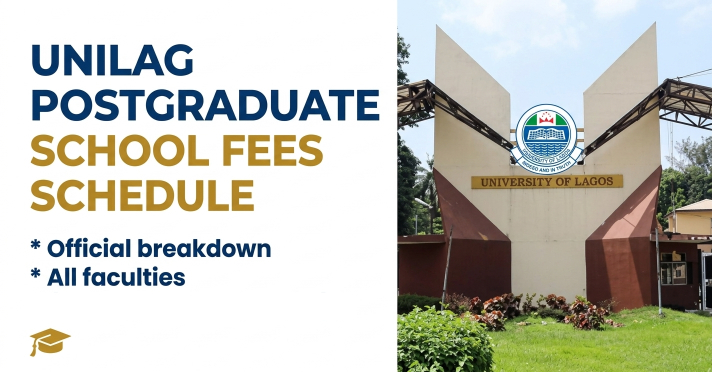
The University of Lagos (UNILAG) runs one of the most reputable and heavily subscribed School of Postgraduate Studies (SPGS) programmes in Nigeria, and prospective and returning students are actively searching for clarity on the UNILAG postgraduate school fees for the 2026/2027 academic session. Whether you are applying fresh into a Postgraduate Diploma, academic or professional Master’s, M.Phil, or PhD programme, or you are a continuing student planning your semester budget, knowing exactly what the UNILAG postgraduate school fees cover: application charges, acceptance fee, obligatory fees, and programme-specific tuition is essential before you approach the payment portal.
This article breaks down the UNILAG postgraduate school fees for PGD, Master’s, and PhD programmes across the university’s faculties, explains the difference between what new and returning postgraduate students pay, and walks you through the exact steps for completing your application and payment on UNILAG’s official School of Postgraduate Studies portal. You will also find guidance on fee variation by faculty, a comparison with previous sessions, and answers to the questions postgraduate applicants ask most often about UNILAG’s postgraduate fees so keep reading before you make any payment.
UNN Postgraduate School Fees 2026/2027: PGD, Masters and PhD Fee Breakdown and Payment Guide
About the University of Lagos’s Postgraduate Programs
The University of Lagos, Akoka, is a first-generation federal university established in 1962 and widely regarded as one of Nigeria’s most prestigious institutions. Its School of Postgraduate Studies (SPGS) coordinates admissions, registration, and fee administration across the university’s faculties including Arts, Education, Engineering, Science, Social Sciences, Law, Business Administration, Environmental Sciences, and the College of Medicine offering Postgraduate Diploma (PGD), academic Master’s (M.A., M.Sc., M.Ed.), professional Master’s (MBA, MPH, and related degrees), M.Phil, and PhD programmes, run on both full-time and part-time tracks.
Because UNILAG’s postgraduate programmes run on a strict semester calendar, timely clearance of the UNILAG postgraduate school fees is taken seriously by the School of Postgraduate Studies. Students who fail to complete payment within the stipulated window risk being barred from semester examinations, losing access to course registration, and in some cases facing deregistration for that semester. If you are planning to resume at UNILAG’s postgraduate school, budgeting for the full UNILAG postgraduate school fees — not just tuition, but every attached levy — well ahead of resumption is the safest approach.
Postgraduate Fee Structure Overview
The UNILAG postgraduate school fees are not a single flat figure; they are made up of several components billed together as one total per session or semester, depending on the programme. These typically include:
- Application fee — a flat, one-time charge paid by every fresh applicant before admission is considered
- Acceptance fee — paid only once, after an offer of admission is confirmed
- PG Obligatory/Utility fee — a recurring charge covering library, ICT, and general service costs, usually billed higher in the first year and reduced in subsequent years
- Programme-specific tuition — the component that varies most sharply, depending on whether your programme is an academic Master’s, a professional Master’s, a PGD, or a PhD, and whether you study full-time or part-time
- Prospectus and departmental fees — smaller charges tied to your specific department
UNILAG’s postgraduate fees also differ sharply by programme category. Standard academic Master’s programmes (M.Sc., M.A., M.Ed.) in most faculties cluster around ₦75,000–₦150,000 in tuition, while professional and high-demand programmes — MBA, Public Health, Criminology, and similar specialized Master’s — can run from ₦150,000 well above ₦400,000, particularly for the part-time MBA. International and foreign-national applicants are billed at a significantly higher tuition band, often quoted in US dollars, especially within specialized centres.
UNILAG Postgraduate Fee Breakdown (2026/2027)
Below is the itemized UNILAG postgraduate school fees schedule most consistently reported across the School of Postgraduate Studies and its affiliated centres.
Application and Obligatory Charges (All Programmes)
| Fee Item | Amount |
|---|---|
| Application Fee | ₦40,000 |
| Acceptance Fee (new students, one-time) | ₦61,500 |
| Prospectus Fee | ₦5,000 |
| PG Obligatory/Utility Fee — Year 1 | ₦64,500 |
| PG Obligatory/Utility Fee — Year 2 and beyond | ₦16,000 |
| Departmental Fees | ₦3,000 – ₦20,000 |
| Application Edit Fee (after final submission) | ₦2,500 |
| Accommodation (optional) | From ₦58,000 |
Representative Tuition by Programme Category (Per Session, Full-Time Unless Noted)
| Programme | Tuition |
|---|---|
| Standard M.Sc./M.A./M.Ed. (most Arts, Education, Engineering, Science departments) | ₦75,000 – ₦112,500 |
| Master of Environmental Design | ₦75,000 |
| Master of Research and Public Policy | ₦150,000 |
| Master of Criminology | ₦250,000 |
| M.Ed. (Part-Time) | ₦75,000 |
| Master of Public Health — Full-Time | ₦150,000 |
| Master of Public Health — Part-Time | ₦225,000 |
| MBA — Full-Time | ₦250,000 |
| MBA — Part-Time | ₦450,000 |
| Master of International Trade (MIT) | ₦292,500 |
| Masters in Industrial and Labour Relations (MILR) | ₦146,500 |
| International Relations (MPIA) | ₦146,500 |
⚠️ Disclaimer: The application fee (₦40,000) and acceptance fee (₦61,500) are confirmed directly from the School of Postgraduate Studies’ own admission announcements. The programme-specific tuition figures above are estimates compiled from the most widely and consistently reported amounts across previous sessions, as UNILAG management has not published a single unified tuition circular covering every postgraduate programme for the 2026/2027 session at the time of writing — and all fees are explicitly subject to review every session by the School of Postgraduate Studies.
Tuition also varies further for specialized centres and institutes, and for international/non-Nigerian applicants, who are typically billed in US dollars. Please confirm the exact, current amount for your specific programme via the official UNILAG SPGS portal (spgs.unilag.edu.ng) before making any payment.
New vs. Returning Postgraduate Students
Fresh postgraduate admits into UNILAG pay a number of one-time charges that returning students do not encounter again after their first session:
- Application fee — ₦40,000, paid before an admission decision is made
- Acceptance fee — a flat, non-refundable ₦61,500, paid only after an offer of admission is confirmed
- Full PG Obligatory/Utility fee — new students pay the higher Year 1 rate (₦64,500); returning students pay the reduced Year 2-and-beyond rate (₦16,000)
- Prospectus fee — ₦5,000, paid once at the point of registration
Returning postgraduate students, by contrast, pay only the recurring tuition and the reduced obligatory/utility fee each session, without the application fee, acceptance fee, or prospectus charge attached. Continuing M.Phil and PhD students additionally pick up research-related costs as they progress toward thesis submission and defence.
Acceptance Fee & Additional Charges
Every newly admitted postgraduate student at UNILAG is required to pay a non-refundable acceptance fee of ₦61,500 to confirm their intention to take up the offer of admission. This fee must be paid before proceeding to full registration and tuition payment; without it, your admission offer is not considered formally accepted, and the slot may be reassigned.
Beyond the acceptance fee and the obligatory/tuition fees already itemized, postgraduate students should budget for a few additional charges:
- Departmental fees (₦3,000 – ₦20,000) — vary by specific department and are billed alongside tuition
- Accommodation — UNILAG postgraduate students who require campus housing pay separately, from roughly ₦58,000, priced according to the hostel and room type
- Application edit fee (₦2,500) — charged if you need to amend your application after final submission
- Thesis/research supervision and defence fees — payable by M.Phil and PhD candidates in the semesters where proposal defence, internal review, and final thesis submission take place
- Late payment penalty — applied automatically once the payment deadline for a semester passes
Step-by-Step Payment Portal Guide
UNILAG postgraduate school fees and application payments must be made strictly through the official School of Postgraduate Studies channels, never through any agent, third party, or informal bank transfer arrangement. Here is the process:
- Visit the SPGS portal — go to spgs.unilag.edu.ng, the School of Postgraduate Studies’ official website, to begin a fresh application or log in as an existing student.
- Check your eligibility and create an account — new applicants review the eligibility criteria for their intended programme, then register with a valid email address and phone number.
- Pay the application fee — generate an invoice for the ₦40,000 non-refundable application fee and pay via the portal’s REMITA-integrated payment channel, either online with a card or at any bank using the generated Remita Retrieval Reference (RRR).
- Complete the online application form — fill in your bio-data, academic history, and programme selection; note that editing after final submission attracts a ₦2,500 fee, so review every entry carefully before submitting.
- Upload your documents — scan and upload your degree certificate or statement of result, official transcript, NYSC discharge/exemption certificate, and passport photograph; M.Phil and PhD applicants should also confirm supervisor availability in their intended department before or during this stage.
- Monitor your application status — check your email and the portal regularly for screening invitations, interview schedules, or the outcome of your application.
- Pay the acceptance fee — once you receive an offer of admission, generate and pay the ₦61,500 acceptance fee through the portal within the stated deadline to secure your slot.
- Pay your obligatory and tuition fees — log back into the portal, select your programme, generate the invoice covering your PG Obligatory/Utility fee and programme-specific tuition, and pay online or at any Remita-enabled bank.
- Confirm payment on the portal — return to the portal after each payment and verify that your payment status reflects as “confirmed” before proceeding to registration.
- Print your receipts — save a digital copy and print a physical copy of every payment receipt for your departmental and SPGS registration file.
UNIZIK Postgraduate School Fees 2026/2027 Session: official PGD, Masters & PhD Tuition Breakdown
Installment Payment & Financial Aid
UNILAG’s School of Postgraduate Studies generally expects tuition and obligatory fees to be cleared in full at the point of registration for each session, though some part-time professional programmes — particularly the MBA — have historically allowed a split payment arrangement given the significantly higher tuition involved. Students who need to pay in installments should confirm the exact terms directly with their department or the SPGS finance office, since this is not uniformly advertised across all programmes.
For funding support, postgraduate students at UNILAG can explore:
- Institutional scholarships and assistantships — periodically announced by specific centres, such as the Africa Centre of Excellence for Genomics of Infectious Diseases (ACEGID) and similar World Bank-supported centres, which offer tuition support based on nationality and programme
- TETFund-linked opportunities — relevant to academic staff of TETFund-eligible institutions sponsored for further postgraduate studies
Comparison to Previous Session
The UNILAG postgraduate school fees for the 2026/2027 session show the application fee holding steady at ₦40,000 and the acceptance fee at ₦61,500, consistent with recent sessions. The core fee structure — application, acceptance, obligatory/utility charges, and programme-specific tuition — has remained consistent in format, with the School of Postgraduate Studies explicitly reserving the right to review tuition figures every session; professional and specialized programmes such as the MBA and Public Health have seen the most noticeable upward movement in recent cycles compared to standard academic Master’s programmes.
Scam Prevention & Safety Tips
Postgraduate applicants and students are frequently targeted by fraudsters posing as UNILAG admission officers or “PG agents.” Protect yourself with these precautions:
- Only pay UNILAG postgraduate school fees through the official SPGS portal (spgs.unilag.edu.ng) or a Remita-generated RRR at a recognized bank — never to a personal account
- Ignore anyone who contacts you privately claiming they can “guarantee” postgraduate admission or waive your screening in exchange for a separate payment
- Always confirm your specific programme’s current tuition directly with the School of Postgraduate Studies before paying, especially for professional programmes where fees vary widely
- Keep every payment receipt, RRR confirmation, and portal screenshot until your admission, registration, and clearance for that session are fully confirmed
- Report any suspicious fee requests to the School of Postgraduate Studies office immediately
Frequently Asked Questions
Has UNILAG increased postgraduate fees for the 2026/2027 session? UNILAG’s application fee (₦40,000) and acceptance fee (₦61,500) have remained stable compared to the prior session, though the School of Postgraduate Studies explicitly reviews tuition every session, and professional programmes such as the MBA have shown the most noticeable upward movement in recent years.
Can I pay UNILAG’s postgraduate school fees in installments? Tuition is generally expected in full at registration, though some part-time professional programmes, especially the MBA, have historically allowed a split payment arrangement; confirm the current terms with your department or the SPGS finance office.
What is the acceptance fee for UNILAG’s postgraduate programme? The postgraduate acceptance fee is a flat, non-refundable ₦61,500, applicable across PGD, Master’s, and PhD applicants, payable only after you have received an official offer of admission.
Why does UNILAG’s MBA cost so much more than a standard M.Sc.? Professional programmes like the MBA are priced separately from standard academic Master’s degrees because they are run as self-funding, high-demand programmes; a full-time MBA runs around ₦250,000 and the part-time MBA around ₦450,000, compared to ₦75,000–₦112,500 for most standard M.Sc./M.A./M.Ed. programmes.
Conclusion
Understanding the full UNILAG postgraduate school fees structure — from the ₦40,000 application fee, through the ₦61,500 acceptance fee, to tuition ranging from ₦75,000 for a standard academic Master’s up to ₦450,000 for a part-time MBA puts you in a much stronger position to plan your registration and avoid last-minute payment stress. Always pay strictly through the official UNILAG SPGS portal, keep your receipts, and confirm your exact programme fee with the School of Postgraduate Studies before transferring any money, since figures are reviewed every session.
Bookmark MasterPG.com.ng and check back for updates as UNILAG releases further details on its 2026/2027 postgraduate fee schedule. For the admission requirements and current admission list for your specific postgraduate programme at the University of Lagos, see our companion guides on MasterPG.com.ng.

Asuku Abdulmalik is an education content writer and the founder of MasterPG, a Nigerian postgraduate information platform focused on postgraduate admissions and school fees. With a background in researching and writing educational content, Asuku is passionate about making postgraduate information easier for students and prospective applicants to find and understand. Through MasterPG, he covers admission requirements, application forms, deadlines, admission lists, school fees, and practical guides for postgraduate students across Nigerian universities. He is committed to keeping MasterPG’s content clear, accurate, and regularly updated, while encouraging readers to verify important details with the relevant institution’s official sources before making any decisions.
Founder & Education Content Writer, MasterPG
Your Guide to Postgraduate Studies in Nigeria.