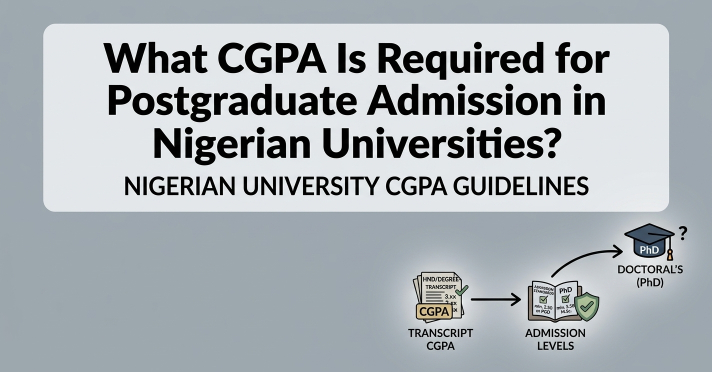
Few questions worry Nigerian graduates more than this one: what CGPA is required for postgraduate admission in Nigerian universities? Applicants with a strong result want to know whether it opens doors to competitive departments, while those with a modest result fear they are shut out completely. This guide answers the question for the two most common entry points, the Master’s degree and the Postgraduate Diploma (PGD), using the class of degree and CGPA ranges most Nigerian universities recognise.
By the end, you will know the usual minimum for each programme, how classes of degree map to CGPA, and what your options are if your result falls short. You will also see worked scenarios and a comparison of your realistic next moves. The Nigerian context matters because the National Universities Commission sets broad standards, yet each university and department decides its own cutoff, entrance screening, and extra conditions, so published thresholds should always be confirmed with the school. Read this before you apply, and you will avoid the most common and costly admission mistakes this session.
Quick Answer
The CGPA required for postgraduate admission in Nigerian universities depends on the programme. For a Master’s degree, most schools ask for at least a Second Class Lower degree, which on the common 5-point scale is a CGPA of 2.40 or above, although some competitive departments want a Second Class Upper (3.50 and above). For a PGD, many schools accept a Third Class degree or better, and some accept a pass degree or a credit-level HND. Where a school sets a numeric minimum, it publishes it in its own postgraduate requirements, so always confirm with the institution.
Key takeaway: Think in classes of degree first, then CGPA. A 2.40 CGPA (Second Class Lower) is the usual floor for a Master’s degree, and a Third Class is often enough for a PGD, but each school and department can set its own rule.
Why This Matters for Postgraduate Applicants
Your CGPA is the first thing an admissions panel checks. If your result falls below a department’s cutoff, your application can be rejected before anyone reads your statement of purpose, and the application fee is gone. Applicants who assume that any degree qualifies them for a Master’s degree often discover the real requirement only after paying.
On the other hand, many applicants with modest results give up too early. A lower CGPA rarely ends your postgraduate plans, because routes such as a PGD, a related field, or work experience can open a path. Understanding the CGPA required for postgraduate admission in Nigerian universities lets you choose the right programme, shortlist the right schools, and decide whether to apply, upgrade your result, or take a different route.
The Short Verdict
Here is the honest summary of the minimum CGPA for postgraduate admission in Nigeria:
- Master’s degree: Commonly a Second Class Lower (CGPA of 2.40 to 3.49) or better. Some departments and professional programmes require a Second Class Upper (CGPA of 3.50 to 4.49 or better).
- PGD: Commonly a Third Class degree or better, and sometimes a pass degree or an HND at credit level, depending on the school and field.
- Master’s after a PGD: Many schools allow graduates with lower classes to proceed to a Master’s degree after earning at least a credit-level pass in the PGD.
- PhD: Typically a Master’s degree with a CGPA of around 3.50 on a 5-point scale, or about 60 percent, in many universities.
Warning: These are common patterns, not national rules. A single university can set different cutoffs for different departments, so never rely on a figure you saw on social media.
Class of Degree and CGPA at a Glance
Most Nigerian universities use a 5-point scale. The table below shows the commonly used classification and how it generally relates to postgraduate entry. A few institutions use a different scale, so check your transcript.
| Class of degree | CGPA (5-point scale) | Typical standing for postgraduate entry |
|---|---|---|
| First Class | 4.50 to 5.00 | Eligible for Master’s degrees, including competitive departments |
| Second Class Upper (2:1) | 3.50 to 4.49 | Eligible for Master’s degrees, and meets stricter department cutoffs |
| Second Class Lower (2:2) | 2.40 to 3.49 | Usually eligible for Master’s degrees, subject to department rules |
| Third Class | 1.50 to 2.39 | Often eligible for a PGD, and sometimes a route to a Master’s degree afterwards |
| Pass | 1.00 to 1.49 | May be considered for a PGD in some schools, but options are limited |
Note: If your university uses a 4-point or other scale, do not compare your CGPA directly with these ranges. Use your class of degree, and ask the school how it converts your result.
What the Requirements Look Like in Practice
Published postgraduate pages from Nigerian universities show the typical pattern. At the time of writing, Niger Delta University’s postgraduate requirements describe PGD entry for graduates with at least a Third Class honours degree, or HND holders with at least a credit-level pass, and Master’s entry for graduates with at least a Second Class Lower degree. The University of Nigeria, Nsukka describes Master’s admission for graduates with at least a good second class honours degree, or those holding a relevant PGD with at least a credit-level pass, along with a postgraduate screening test for applicants.
These examples show how much schools differ in wording and detail. They are illustrative only, and the current requirements for your target school may have changed, so confirm them on the institution’s official postgraduate page.
Factors That Shape the Answer
Several factors decide whether your CGPA is enough for a particular programme.
1. The university’s own rule. Each university decides its cutoff, so a CGPA that qualifies you in one school may fall short in another. Start by reading the postgraduate admission page of your target institution.
2. The department or faculty. Competitive fields, such as medicine-related programmes, engineering, law, and some sciences, may set higher thresholds than other departments in the same university. Always check at the department level.
3. The type of programme. A PGD usually has the lowest threshold, a Master’s degree sits above it, and a PhD or MPhil route usually looks at your Master’s CGPA rather than your first degree. Professional programmes may add work experience or professional membership.
4. Your class of degree versus your CGPA. Schools usually state requirements as a class of degree. If you graduated from a university that uses a different scale, the class of degree on your certificate is what counts, so confirm how the school reads it.
5. Screening tests and interviews. Some schools run postgraduate screening tests or interviews, so a strong CGPA does not guarantee admission, and a modest CGPA does not always rule you out when other parts of your application are strong.
6. Relevance of your first degree. Even with a good CGPA, your first degree must be in a relevant field. Otherwise a school may ask you to take a PGD or extra courses before admission to a Master’s programme.
7. HND status. If you hold an HND instead of a university degree, the rules differ. Our guide on whether an HND holder can apply for a Master’s degree in Nigeria explains the usual PGD-first route.
Scenarios: Three Applicants, Three Answers
The scenarios below are illustrative, and the names are fictional.
Scenario 1: Aisha, Second Class Lower in Microbiology (CGPA 2.85). Aisha meets the usual minimum for a Master’s degree in most schools. She should check whether her target department sets a higher cutoff or requires a screening test, and she should build a strong statement of purpose to stand out.
Scenario 2: Tobi, Third Class in Business Administration (CGPA 2.10). Tobi is unlikely to qualify directly for a Master’s degree in many schools. A better plan is to enrol for a PGD in a related field, aim for a credit-level pass or better, and then apply for the Master’s programme, if the school allows that progression.
Scenario 3: Grace, Master’s CGPA of 3.20 and a PhD ambition. Many universities expect a Master’s CGPA of about 3.50 on a 5-point scale for PhD admission. Grace should ask whether the school has an MPhil/PhD route or other conditions for candidates just below the cutoff, and should strengthen her research proposal.
Costs vs Benefits: Your Options if Your CGPA Is Below the Cutoff
If your CGPA falls short, you still have routes. The table below compares them in relative terms, without figures, because fees vary and change often.
| Option | Relative cost and time | Main benefit | Main risk |
|---|---|---|---|
| Apply to a school with a lower cutoff | Low | Fastest route to a Master’s degree | Limited choice of schools and departments |
| Take a PGD first | Higher, since it adds a stage | Opens a path to a Master’s degree with a good result | Extra time and tuition |
| Gain relevant work experience | Varies | Strengthens professional programmes | Does not replace a required class of degree |
| Choose a related or less competitive department | Low | Better chance of meeting the cutoff | May not match your long-term goal |
Note: For actual fees, check the school’s official fee schedule or our Postgraduate School Fees posts.
Common Mistakes to Avoid
- Assuming one national CGPA cutoff exists. Fix: Check each school and department, because thresholds differ.
- Comparing your CGPA with a different scale. Fix: Confirm whether your university uses a 5-point scale, and use your class of degree when in doubt.
- Ignoring screening tests. Fix: Ask whether the school runs a screening test or interview and prepare for it.
- Applying without reading the department’s page. Fix: Read the requirements for your exact programme before you pay.
- Treating a PGD as a formality. Fix: Aim for a strong result, since credit level or above often determines Master’s progression.
- Trusting hearsay. Fix: Use only the school’s official postgraduate page or the postgraduate office.
- Giving up too early. Fix: Explore PGD routes, related departments, and other schools before you decide.
Practical Tips
- Check your class of degree and CGPA on your transcript before you shortlist schools.
- Shortlist at least three universities and compare their cutoffs for your department.
- Write to the postgraduate office if the requirement is unclear, and keep their reply.
- If you fall below the cutoff, consider a PGD route or a related programme.
- Strengthen your application with a clear statement of purpose and strong referees.
- Prepare your documents early, using our guide on documents needed for postgraduate admission in Nigeria.
- Revisit the requirements before each application, because rules change.
Quick checklist (screenshot-friendly):
- I know my class of degree and CGPA scale
- I have checked the target department’s cutoff
- I know whether a screening test is required
- I have a backup school or route
- My documents are complete
- I have written proof of the school’s reply
Nigeria-Specific Considerations
The CGPA required for postgraduate admission in Nigerian universities reflects local practice, so a few realities are worth keeping in mind.
- University autonomy: The National Universities Commission sets broad standards, but each university writes its own postgraduate regulations, which is why cutoffs differ.
- Departmental variation: Even inside one university, departments can set stricter or more flexible thresholds.
- Classification wording: Schools describe requirements differently, such as second class lower, good second class, or credit-level pass, so read the wording carefully.
- PGD as a bridge: Many universities allow a PGD with a good result to qualify graduates for Master’s admission, which gives applicants with lower classes a second chance.
- Screening and extra conditions: Some schools add entrance tests, interviews, or work experience requirements, especially for professional programmes.
- Different scales: A few institutions use different grading scales, so your result may need conversion or interpretation by the school.
Important: Rules, eligibility conditions, and cutoffs vary by school and change over time. Treat this guide as general information and confirm every requirement with the institution’s official admission page or postgraduate school before you apply.
For a school-specific example, see: Related: UDUSOK Postgraduate Courses and Admission Requirements.
Related Costs and Funding
Your CGPA can affect more than admission. Some scholarships and sponsorship schemes set their own minimum grades, so check each one carefully. Fees differ across federal, state, and private universities, so always confirm the current official schedule. To see how postgraduate fees are structured at one school, read our post on FUDMA Postgraduate School Fees, and browse the Postgraduate School Fees category for others.
Funding options worth exploring include:
- Scholarships and fellowships: Many awards set minimum grade conditions and deadlines, so read the eligibility rules early.
- Sector-linked schemes: Some industry-linked funds support postgraduate students in specific fields and may require a higher class of degree.
- Assistantships: Some universities offer graduate or teaching assistantships.
- Employer sponsorship: Some organisations support staff who want to study further.
You Might Also Need: Can an HND Holder Apply for a Master’s Degree in Nigeria?
Frequently Asked Questions
What is the minimum CGPA for Master’s admission in Nigeria? Most universities ask for at least a Second Class Lower degree, which is a CGPA of 2.40 on the common 5-point scale. Some departments set higher cutoffs, so confirm with your target school.
Can I do a PGD with a Third Class degree? Many schools accept Third Class graduates for a PGD, and some accept a pass degree or a credit-level HND. The rule differs by school and department.
Can I do a Master’s degree with a Third Class degree in Nigeria? Usually not directly, but a PGD with a good result can open the door in many schools. Ask the postgraduate office how its progression rule works.
Does a 2.40 CGPA qualify me for a Master’s degree? A 2.40 CGPA is the lower boundary of Second Class Lower on the usual scale, which many schools accept for Master’s entry. Some competitive departments require a higher class, so check your department.
What CGPA do I need for a PhD in Nigeria? Many universities look at your Master’s CGPA, often around 3.50 on a 5-point scale or about 60 percent, though requirements differ. Confirm the exact rule with the school.
Conclusion & Call to Action
The CGPA required for postgraduate admission in Nigerian universities is usually a Second Class Lower for a Master’s degree and a Third Class or better for a PGD, with higher cutoffs in competitive departments. Know your class of degree, check each school’s official rule, and plan a backup route if you fall short.
Bookmark MasterPG.com.ng for more postgraduate updates, and take your next step with our guide: Also Read: Documents Needed for Postgraduate Admission in Nigeria: A Complete Checklist.

Asuku Abdulmalik is an education content writer and the founder of MasterPG, a Nigerian postgraduate information platform focused on postgraduate admissions and school fees. With a background in researching and writing educational content, Asuku is passionate about making postgraduate information easier for students and prospective applicants to find and understand. Through MasterPG, he covers admission requirements, application forms, deadlines, admission lists, school fees, and practical guides for postgraduate students across Nigerian universities. He is committed to keeping MasterPG’s content clear, accurate, and regularly updated, while encouraging readers to verify important details with the relevant institution’s official sources before making any decisions.
Founder & Education Content Writer, MasterPG
Your Guide to Postgraduate Studies in Nigeria.