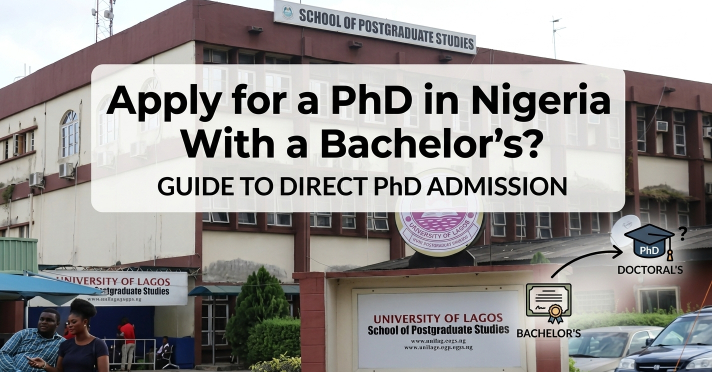
Can you apply for a PhD in Nigeria with a Bachelor’s degree? In most cases, no. Nigerian universities generally require candidates to complete a relevant Master’s degree before admission into a PhD programme. Having a First Class or Second Class Upper degree may strengthen your academic profile, but it does not automatically exempt you from this requirement.
The important distinction is between entering a PhD programme directly after your first degree and progressing through a postgraduate pathway that eventually leads to a PhD. Some institutions offer MPhil/PhD or other structured research routes, but these should not be confused with direct PhD admission from a Bachelor’s degree. This guide explains the usual requirements, how to identify any legitimate alternative, and what to do if you want to become a doctoral researcher in Nigeria.
Can You Get a PhD in Nigeria With Only a Bachelor’s Degree?
For most applicants, the answer is no, not through the standard PhD admission route. A relevant Master’s degree is normally required, alongside the minimum postgraduate grade specified by the university and department.
For example, the University of Ilorin’s published postgraduate admission requirements state that PhD applicants must hold a relevant Master’s degree with at least 60% or a CGPA of 4.0 on a five-point scale. The university also indicates that shortlisted candidates may be required to attend departmental interviews or assessments.
You can check the requirements on the University of Ilorin’s official postgraduate admissions page.
This example illustrates why applicants should not assume that an excellent undergraduate result is enough. Admission depends on the qualifications specified for the particular programme, not just the class of your first degree.
There is also an important difference between a university offering a PhD and that university accepting Bachelor’s degree holders into the programme. Unless the official admission requirements expressly provide for your qualification, do not assume that you are eligible.
Read also: How to Write a Statement of Purpose for Postgraduate Admission in Nigeria
What Routes Are Available After a Bachelor’s Degree?
If your long-term goal is a PhD, there are several academic routes to consider. The right choice depends on your undergraduate result, your intended research field, and the entry rules of your preferred institution.
1. Complete a Master’s Degree Before Applying for a PhD
This is the standard route for most prospective doctoral students in Nigeria.
You first obtain a relevant Master’s degree, such as an MSc, MA, MEd or another qualification appropriate to your field. You then apply for a PhD after meeting the university’s minimum grade and other admission conditions.
A Master’s programme can also help you develop research skills, gain experience with academic writing and identify a suitable PhD research topic.
Who should consider this route?
- Graduates whose universities require a Master’s degree for PhD admission.
- Applicants with Second Class Lower degrees who meet the entry requirements for a suitable Master’s programme.
- Graduates who want to change research areas and need relevant postgraduate preparation.
- Applicants who want to strengthen their research experience before doctoral study.
If your preferred university does not explicitly permit another route, this is the safest option to plan around.
2. Investigate an MPhil/PhD or Similar Research Pathway
An MPhil/PhD programme may allow an eligible postgraduate student to begin at the MPhil stage and progress to full PhD registration after meeting specified academic and research conditions.
However, this does not necessarily mean that you can enter with only a Bachelor’s degree. The entry requirements may still require a Master’s qualification.
The University of Ilorin, for example, publishes an MPhil/PhD route for candidates who meet specified Master’s-level performance conditions. Its published requirements describe an assessment before progression to the PhD stage.
Therefore, when you see the term MPhil/PhD, check two separate questions:
- What qualification must you hold before admission?
- What academic conditions must you satisfy before progressing to the PhD?
Do not treat the name of the programme as proof that it accepts fresh Bachelor’s degree holders.
3. Check Whether a University Explicitly Allows Direct or Combined Entry
If you have a First Class degree and want to avoid completing a separate Master’s programme, you may wish to investigate whether any university offers an officially approved route that fits your circumstances.
Start with the university’s current postgraduate prospectus and the admission requirements for your intended department. Look for explicit statements about admission with a Bachelor’s degree, combined Master’s and doctoral study, or an alternative qualifying pathway.
Do not rely on a general statement that the university accepts outstanding graduates. The published rule must actually cover the qualification you hold.
If the information is unclear, contact the postgraduate school or department in writing before paying an application fee.
Important: This guide does not establish a currently verified list of Nigerian universities that admit candidates directly into PhD programmes with only a Bachelor’s degree. You should confirm any claimed exception from an official, current university source.
Does Your Class of Degree Affect PhD Eligibility?
Yes, your undergraduate result matters, but it is only one part of the admission process.
A First Class degree may help you qualify for competitive Master’s programmes, research opportunities or scholarships. A Second Class Upper degree may also satisfy the undergraduate entry requirements for many postgraduate programmes.
Nevertheless, neither classification automatically gives you the right to enter a PhD programme without a Master’s degree.
Your result becomes relevant in different ways depending on the route you pursue.
| Your undergraduate result | Practical next step |
|---|---|
| First Class | Check the standard Master’s-to-PhD route and investigate any explicitly published alternative pathway. |
| Second Class Upper | Identify suitable Master’s programmes and confirm their requirements. |
| Second Class Lower | Check Master’s admission requirements carefully; a qualifying examination or other conditions may apply. |
| Third Class | Investigate eligible postgraduate diploma programmes and whether a relevant PGD can lead to Master’s admission. |
This table is a planning guide, not a universal admission policy. Universities and departments can set different minimum requirements, and a PGD does not automatically guarantee admission to a Master’s or PhD programme.
What Do Universities Usually Require for PhD Admission?
Although the exact rules vary, prospective PhD students should expect to meet several requirements.
A relevant Master’s degree: Most universities require a postgraduate qualification related to the intended doctoral field. Some departments may consider related disciplines, but applicants should confirm whether additional coursework is required.
A minimum Master’s grade: The university may specify a minimum percentage, CGPA or classification. Do not assume that one institution’s requirement applies to another.
Academic transcripts: The university may require official transcripts from your previous institutions. Arrange these early enough to meet the application deadline.
A research proposal or statement of research interest: Some programmes ask applicants to explain the problem they want to investigate, why it matters and how they intend to study it.
Departmental screening: Depending on the programme, applicants may be assessed through an interview, written examination, research presentation or another selection process.
Research supervision: Your proposed area must fit the department’s research capacity. Ask whether the department can support your intended topic and whether a suitable supervisor may be available.
Other institutional conditions: These may include O’Level requirements, relevant professional qualifications, work experience for certain programmes, or specific documentation.
The university’s current admission advertisement remains the controlling source for the requirements that apply to your application.
Recommended: How to Write a Research Proposal for a Master’s or PhD Application
How to Find Out Whether You Qualify
Before choosing a programme, use the following procedure to verify the entry route.
- Choose your research field. Identify the subject you want to study at doctoral level, such as Chemistry, Economics, Education, Sociology or Engineering.
- Shortlist suitable universities. Start with institutions that offer the relevant postgraduate programme. Do not choose a university solely because it is reputed to admit candidates with strong grades.
- Open the official postgraduate admission page. Find the current prospectus or admission advertisement and locate the requirements for your intended department.
- Check the minimum qualification. Determine whether the programme requires a Master’s degree, an MPhil, a professional qualification or another stated credential.
- Check the grade requirement. Confirm the required percentage or CGPA and the grading scale used by the institution.
- Contact the department if the route is unclear. Ask whether a candidate with your exact qualification can apply and request confirmation of the relevant regulation.
- Compare the time and cost. Check programme duration, tuition, additional charges and whether the route involves progression assessments.
- Apply only after confirming eligibility. Use the official application portal and retain copies of the admission requirements and any written clarification you receive.
This process can help you avoid paying for an application that does not match your qualifications.
Three Examples: Which Route Should You Consider?
The following examples are illustrative. They do not represent guaranteed admission decisions by any university.
Example 1: A graduate with First Class in Chemistry
A graduate with First Class honours wants to proceed straight to a PhD. The first step is to check whether the target university expressly accepts Bachelor’s degree holders into a relevant doctoral or combined programme. If no such route is confirmed, the graduate should apply for a suitable Master’s programme and plan for PhD admission afterwards.
Example 2: A graduate with Second Class Upper in Economics
The graduate wants to pursue a PhD in Development Economics. A practical approach is to identify relevant Master’s programmes, check their minimum undergraduate requirements and choose a programme that provides strong research training. After completing the Master’s degree and satisfying the doctoral entry conditions, the graduate can apply for a PhD.
Example 3: A graduate with Second Class Lower in Sociology
The graduate should first identify Master’s programmes that accept their result. Some universities may impose additional conditions, while others may not offer admission for that particular programme. If direct Master’s admission is unavailable, the graduate can investigate a relevant PGD and confirm whether it is an accepted route into the desired Master’s programme.
In all three cases, the appropriate next step depends on the published rules of the university and department.
Is It Better to Do a Master’s First or Look for a Direct PhD Route?
For most Nigerian graduates, the Master’s-first route is the more dependable plan because it aligns with the standard entry requirements published by many universities.
| Consideration | Master’s first, then PhD | An explicitly approved alternative route |
|---|---|---|
| Eligibility | Usually follows the standard postgraduate pathway | Depends on the exact published entry conditions |
| Research preparation | Provides a dedicated stage for postgraduate research training | May combine postgraduate study and doctoral progression |
| Applications | Usually involves separate admissions | May involve a combined application or progression process |
| Time and cost | Requires planning for both qualifications | Depends on programme structure and progression rules |
| Main risk | Meeting the PhD grade requirement after the Master’s | Assuming eligibility without checking the official rules |
There is no guarantee that an alternative route will save time or money. Some programmes include additional coursework, assessments or progression requirements. Compare the actual programme regulations before making a decision.
Common Mistakes to Avoid
Assuming First Class means automatic PhD eligibility. A strong undergraduate result does not override a published Master’s requirement.
Confusing MPhil/PhD with direct PhD admission. An MPhil/PhD programme may still require applicants to hold a Master’s degree.
Trusting an outdated admission advert. Requirements can change between sessions. Always check the latest official publication.
Relying entirely on third-party education blogs. Such guides can help you discover a programme, but confirm eligibility through the university itself.
Ignoring departmental requirements. A university-wide page may not include every condition imposed by a particular department.
Paying before confirming your route. If the entry requirements are unclear, seek written clarification first.
Assuming a PGD automatically qualifies you for a PhD. A PGD may help you meet the entry requirements for certain Master’s programmes, but it is not generally a substitute for a required Master’s degree.
How Much Does the Route Cost?
There is no single cost for pursuing a PhD in Nigeria. Your total expenditure depends on the university, discipline, mode of study and duration of the programme.
If you follow the Master’s-first route, budget for the Master’s programme and then the PhD. Potential expenses include:
- Application and screening charges.
- Acceptance and registration fees.
- Tuition and other university charges.
- Research materials, laboratory work or fieldwork.
- Thesis preparation, printing and binding.
- Accommodation, transport and daily living expenses.
Before accepting admission, check the institution’s official postgraduate fee schedule for each stage. Do not assume that a combined or alternative route is cheaper simply because it involves one admission process.
You should also investigate scholarships, research grants, assistantships and employer support where available. Check the current eligibility conditions before relying on any funding source.
Frequently Asked Questions
Can I do a PhD directly after a Bachelor’s degree in Nigeria?
Usually not through the standard route. Most universities require a relevant Master’s degree. Only consider an exception if the university’s current official requirements expressly allow your qualification.
Can I get a PhD in Nigeria with First Class honours?
First Class honours can strengthen your academic profile, but it does not automatically remove the Master’s degree requirement. Check the rules for the specific programme.
Can someone with Second Class Upper apply for a PhD without a Master’s?
Do not assume so. Second Class Upper may meet an undergraduate requirement for certain postgraduate programmes, but the PhD entry rule must explicitly permit the qualification you hold.
Can I enter an MPhil/PhD programme with a Bachelor’s degree?
The answer depends on the institution’s entry regulations. Some MPhil/PhD pathways require a Master’s degree before admission. Check the qualification requirement separately from the progression conditions.
Can I use a PGD to qualify for a PhD?
A PGD may provide a route into an eligible Master’s programme, depending on the university’s regulations. If the PhD requires a Master’s degree, you should not assume that a PGD alone will satisfy that condition.
Can I apply for a PhD abroad with only a Bachelor’s degree?
Some overseas institutions may offer doctoral pathways for applicants with exceptional undergraduate records, while others require a Master’s degree. Requirements differ by country, university and discipline, so check the official programme page before applying.
How long does it take to complete a PhD in Nigeria?
The duration depends on the institution, programme and mode of study. For example, the University of Ilorin publishes a standard full-time PhD duration of 36 to 60 calendar months. Other programmes may specify different periods, so consult the current regulations for your intended course.
Conclusion
Can you apply for a PhD in Nigeria with a Bachelor’s degree? In most cases, you should expect to complete a relevant Master’s degree first. A First Class or Second Class Upper result may give you more postgraduate options, but it is not proof that you qualify for direct PhD admission.
Start by identifying your research field, checking official university requirements and confirming the exact qualification needed. If a university advertises a special or combined route, verify its entry conditions in writing before paying an application fee.
For more guidance, explore MasterPG.com.ng for postgraduate admission requirements, application information and school-fee guides. You may also find these topics useful:
- Related: Difference Between PGD, Master’s, MPhil, MA and MEng in Nigeria
- Also Read: What CGPA Is Required for Postgraduate Admission in Nigerian Universities?
- Explore: Postgraduate School Fees in Nigerian Universities

Asuku Abdulmalik is an education content writer and the founder of MasterPG, a Nigerian postgraduate information platform focused on postgraduate admissions and school fees. With a background in researching and writing educational content, Asuku is passionate about making postgraduate information easier for students and prospective applicants to find and understand. Through MasterPG, he covers admission requirements, application forms, deadlines, admission lists, school fees, and practical guides for postgraduate students across Nigerian universities. He is committed to keeping MasterPG’s content clear, accurate, and regularly updated, while encouraging readers to verify important details with the relevant institution’s official sources before making any decisions.
Founder & Education Content Writer, MasterPG
Your Guide to Postgraduate Studies in Nigeria.