Choosing a postgraduate qualification can be confusing when different universities offer several types of master’s degrees. MSc, MA, MEng, MBA and MPhil are all postgraduate qualifications, but they do not serve exactly the same purpose. Some focus on scientific or technical knowledge, others develop professional and managerial skills, while another places greater emphasis on independent research. Understanding the difference between MSc, MA, MEng, MBA and MPhil degrees can help prospective students select a programme that matches their previous education, career plans and long-term academic ambitions.
In Nigeria, the right choice depends on more than the abbreviation printed on a certificate. Universities determine programme structures, admission requirements, research expectations and approved areas of specialisation within the applicable academic standards. A qualification that suits someone planning to become a university researcher may not be the most suitable option for an experienced business professional seeking management responsibilities. This guide explains what each degree means, compares their major features, discusses their admission requirements and career applications, and shows how to choose between them.
Quick Answer: What Is the Difference Between MSc, MA, MEng, MBA and MPhil?
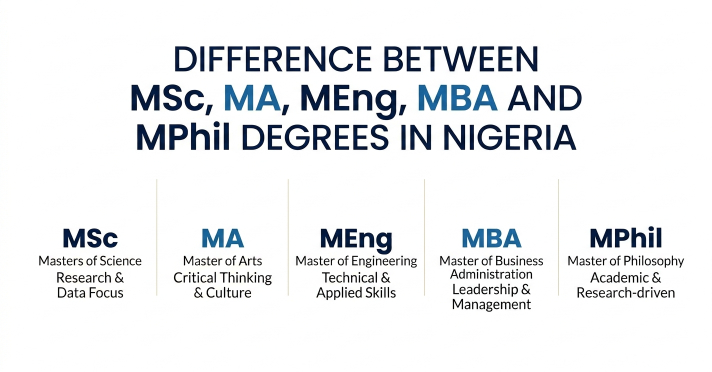
The main difference between MSc, MA, MEng, MBA and MPhil degrees is their academic focus and intended purpose.
- MSc (Master of Science): Focuses on scientific, analytical, technical or research-based study in subjects such as chemistry, computer science, economics and mathematics.
- MA (Master of Arts): Commonly focuses on humanities, languages, social sciences, communication and related fields, depending on the university.
- MEng (Master of Engineering): Concentrates on advanced engineering knowledge, technical design, systems and engineering practice.
- MBA (Master of Business Administration): Develops business, leadership, management, finance, strategy and organisational decision-making skills.
- MPhil (Master of Philosophy): Emphasises advanced academic research and the development of independent research skills, often in preparation for doctoral study.
Key takeaway: Choose your postgraduate degree based on your intended career, previous qualification, research interests and the entry requirements of your preferred university—not simply because one degree title sounds more prestigious than another.
Why This Difference Matters for Postgraduate Applicants
Understanding the difference between MSc, MA, MEng, MBA and MPhil degrees matters because postgraduate study requires a significant investment of money, time and effort. Choosing the wrong programme can lead to admission difficulties, unnecessary expenses or a qualification that does not fit your professional goals.
Consider someone with a bachelor’s degree in mechanical engineering who wants to become a specialist in industrial design. An MEng programme may offer more relevant technical training than an MBA. However, if the same graduate wants to move into business leadership and manage an engineering company, an MBA may be a more suitable option.
Similarly, a graduate who wants to investigate language development, literature or communication may find an MA more relevant than an MSc, depending on the programmes available. Someone planning a research career may need to compare an MSc with a substantial dissertation against an MPhil designed around independent research.
These distinctions also affect admission eligibility. A university may require an applicant to hold a relevant undergraduate degree, meet a specified grade threshold or satisfy additional departmental conditions. Some MBA programmes may also consider professional experience, although this is not a universal requirement.
Before paying for an application form, check the official postgraduate admission notice, the department’s requirements and the programme structure. The National Universities Commission (NUC) oversees academic standards and programme accreditation in the Nigerian university system, but applicants must still verify the approval and requirements of their chosen institution and programme.
Side-by-Side Comparison of MSc, MA, MEng, MBA and MPhil
The table below summarises the principal differences between these five qualifications.
| Feature | MSc | MA | MEng | MBA | MPhil |
|---|---|---|---|---|---|
| Full meaning | Master of Science | Master of Arts | Master of Engineering | Master of Business Administration | Master of Philosophy |
| Main focus | Scientific, analytical or technical study | Humanities, arts and related disciplines | Engineering and technical practice | Business and management | Advanced academic research |
| Typical subject areas | Sciences, computing, statistics, economics | Languages, history, literature, communication | Civil, mechanical, electrical engineering | Management, finance, marketing, strategy | Research within a recognised discipline |
| Teaching approach | Coursework, practical work and research may be combined | Coursework, critical analysis and research may be combined | Advanced technical coursework and projects | Case studies, coursework, projects and management analysis | Research-led study, sometimes with coursework |
| Research emphasis | Varies by programme | Varies by programme | Applied research or technical projects may feature | Usually applied business analysis, with research varying by programme | Generally strong |
| Typical applicant | Graduate seeking advanced subject knowledge | Graduate seeking advanced knowledge in an arts-related field | Graduate seeking advanced engineering specialisation | Graduate seeking business or management development | Graduate seeking deeper research training |
| Possible career directions | Scientific, analytical, technical or academic roles | Cultural, communication, humanities or academic roles | Engineering, technical consultancy or project roles | Management, consulting, entrepreneurship or leadership | Research, academia or preparation for doctoral study |
| Admission requirements | Relevant degree and departmental criteria | Relevant degree and departmental criteria | Relevant engineering or approved related qualification | Degree and programme-specific criteria; experience may be required | Master’s-level background or another route specified by the university |
| Duration | Set by the institution | Set by the institution | Set by the institution | Set by the institution | Set by the institution |
| Cost | Varies by school and department | Varies by school and department | Varies by school and technical facilities | Varies by school and programme format | Varies by school and research requirements |
Important: These are general descriptions, not universal rules. Universities may structure programmes differently, and some disciplines can be offered under different degree titles. Always compare the actual curriculum, admission conditions and award requirements.
MSc Explained: Master of Science
The Master of Science, commonly written as MSc or M.Sc., is a postgraduate degree awarded in many scientific, analytical, technical and other disciplines. It allows graduates to develop advanced knowledge of a subject and may prepare them for specialised employment, research or further academic study.
What Does an MSc Programme Involve?
An MSc programme may combine lectures, seminars, laboratory work, data analysis, practical assignments, examinations and an independent research project. The exact combination depends on the discipline.
For example, an MSc in Computer Science may cover algorithms, software engineering, artificial intelligence, cybersecurity or data science. An MSc in Chemistry may involve laboratory experiments, chemical analysis and research. An MSc in Economics may focus on economic theory, statistics, econometrics and policy analysis.
Some programmes have a strong practical orientation, while others place greater emphasis on theoretical knowledge and research. Therefore, applicants should not assume that every MSc programme has the same structure or level of research intensity.
Who Should Consider an MSc?
An MSc may be suitable if you want to:
- Develop advanced knowledge in your undergraduate discipline.
- Move into a specialised technical or analytical role.
- Strengthen your preparation for academic research.
- Build skills relevant to scientific investigation or evidence-based decision-making.
- Meet the academic requirements for a particular job or subsequent qualification, where applicable.
For example, a graduate with a bachelor’s degree in mathematics who wants to work in statistical analysis could consider an MSc in Statistics or a related programme, provided they satisfy its entry requirements.
Advantages and Limitations of an MSc
One advantage of an MSc is the opportunity to develop specialised knowledge and, where included, practical or research skills. It can support progression into technical employment or academic work.
However, an MSc does not automatically guarantee employment, professional registration or eligibility for every PhD programme. Employers may also consider experience, relevant technical skills and other qualifications. Doctoral admission depends on the university’s rules and the applicant’s academic record.
MA Explained: Master of Arts
The Master of Arts, commonly written as MA or M.A., is a postgraduate qualification frequently associated with humanities, languages, literature, history, communication and some social science disciplines.
Its primary purpose is to deepen a student’s understanding of a subject through advanced study, critical analysis, interpretation and, in many programmes, research.
What Does an MA Programme Involve?
An MA may involve lectures, reading assignments, seminars, essays, presentations, examinations and a dissertation or research project. Students may be expected to analyse arguments, interpret texts, evaluate historical evidence or investigate social and cultural questions.
For instance, an MA in English may cover literary criticism, language, literature or related areas. An MA in History may examine historical records, historical interpretation and research methods. An MA in Communication Studies may focus on media, communication theory, public communication or related topics.
The precise curriculum depends on the department and institution. The distinction between an MA and an MSc is not always a simple division between arts and science, because some social science subjects can be offered under either title.
Who Should Consider an MA?
An MA may suit graduates who want to:
- Specialise in humanities, languages, literature or related disciplines.
- Improve their analytical, communication or research abilities.
- Prepare for work in publishing, media, cultural organisations or related sectors.
- Pursue further academic study in a relevant field.
- Develop subject knowledge for roles that value advanced disciplinary training.
A graduate interested in literature, for example, might choose an MA in English rather than an MSc in a scientific discipline. A communication graduate could compare an MA in Communication Studies with other related postgraduate programmes based on their career objectives.
Advantages and Limitations of an MA
An MA can strengthen subject expertise, written communication, critical thinking and research ability. These skills can be valuable in education, media, cultural institutions, public service and other fields.
Its value nevertheless depends on the quality and relevance of the programme, the student’s skills and the expectations of prospective employers. An MA is not automatically better or worse than an MSc; the relevant question is whether its content supports the intended outcome.
MEng Explained: Master of Engineering
The Master of Engineering, commonly written as MEng or M.Eng., is a postgraduate qualification focused on advanced engineering knowledge and practice. It is designed for further study in engineering disciplines and may include technical design, analysis, modelling, testing, project work and applied research.
What Does an MEng Programme Involve?
Depending on the institution and specialisation, an MEng programme may cover engineering design, advanced materials, structural analysis, energy systems, manufacturing, electrical networks, control systems or other technical subjects.
For example, an applicant interested in designing more efficient power systems may investigate an MEng programme in Electrical Engineering. A civil engineering graduate may consider an MEng in Structural Engineering or another relevant specialisation.
Engineering programmes may require access to laboratories, specialist equipment, computing facilities or practical project resources. The amount of hands-on work differs between programmes.
Who Should Consider an MEng?
An MEng may be appropriate if you want to:
- Deepen your engineering expertise.
- Develop advanced technical or design skills.
- Work towards specialised engineering or consultancy roles.
- Undertake technical projects involving real-world engineering problems.
- Build a stronger academic foundation for further research in engineering.
A graduate with a relevant engineering bachelor’s degree who wants to specialise in structural design should compare the MEng options available at universities offering the appropriate programme.
Advantages and Limitations of an MEng
An MEng may help graduates develop specialised engineering knowledge and demonstrate advanced study in a relevant technical field. Its usefulness depends on the programme’s content, practical opportunities and relationship to the work the graduate wants to do.
However, completing an MEng does not automatically grant professional engineering registration or replace other requirements imposed by relevant professional bodies. Applicants should verify any registration, licensing or professional-experience requirements applicable to their intended role.
It is also important not to confuse every MEng award with an integrated undergraduate master’s degree offered in some countries. In Nigeria, applicants should check the exact postgraduate programme and entry route advertised by the institution.
MBA Explained: Master of Business Administration
The Master of Business Administration, or MBA, is a postgraduate qualification focused on business administration, organisational management and leadership. It is generally intended to help students understand how organisations operate, allocate resources, develop strategy and make business decisions.
Unlike an MSc in a specialised scientific subject or an MEng in engineering, an MBA usually takes a broader management perspective.
What Does an MBA Programme Involve?
MBA programmes may cover financial management, accounting, marketing, operations, human resources, business strategy, entrepreneurship, organisational behaviour and leadership.
Teaching may involve case studies, group projects, business simulations, presentations, examinations and practical assignments. Some programmes also require a research project or dissertation, depending on the institution.
For example, a professional working in a bank who wants to move into a management position might consider an MBA to develop a broader understanding of organisational strategy, finance and leadership.
Who Should Consider an MBA?
An MBA may suit people who want to:
- Develop business management and leadership skills.
- Progress towards supervisory or managerial positions.
- Understand finance, marketing and organisational strategy.
- Establish or expand a business.
- Move from a specialist role into a broader business role.
An MBA may also be open to graduates from different academic backgrounds, subject to the institution’s admission requirements. Some programmes require relevant work experience, while others accept applicants who meet specified academic criteria without a universal minimum experience requirement.
Advantages and Limitations of an MBA
An MBA can provide broad management knowledge and opportunities to learn from classmates with different professional backgrounds. It may be particularly useful for applicants whose goals involve business leadership, entrepreneurship or organisational management.
However, an MBA does not guarantee promotion, a higher salary or employment in a management role. Its practical value depends on the curriculum, institution, professional experience, networking opportunities and the applicant’s ability to apply what they learn.
Before choosing an MBA, check whether the programme is recognised for your intended purpose and whether its schedule, teaching format and costs suit your circumstances.
MPhil Explained: Master of Philosophy
The Master of Philosophy, or MPhil, is a postgraduate qualification with a strong emphasis on advanced research. It is commonly associated with developing the ability to investigate a research question systematically, evaluate existing scholarship and produce an independent academic dissertation.
Although the word “philosophy” appears in its name, an MPhil is not necessarily a degree in the academic subject of philosophy. Universities may offer MPhil programmes in different disciplines.
What Does an MPhil Programme Involve?
An MPhil programme commonly involves identifying a research problem, reviewing relevant literature, developing research questions, selecting appropriate methods, collecting or analysing evidence and presenting the findings in a dissertation.
Some programmes include taught courses or research-methods training. Others are predominantly research-based. The structure depends on the institution and discipline.
For example, a graduate who wants to investigate how agricultural practices affect crop productivity may pursue an appropriate research-based postgraduate route. An MPhil could be suitable if the university offers it in the relevant field and the applicant meets the admission criteria.
Who Should Consider an MPhil?
An MPhil may be appropriate if you want to:
- Develop advanced independent research skills.
- Investigate a specific academic question in depth.
- Prepare for doctoral research where the programme is recognised as a suitable route.
- Strengthen your ability to design and conduct research.
- Pursue an academic or research-oriented career.
MPhil admission requirements can differ significantly from those for taught master’s programmes. Some universities consider applicants whose previous master’s results do not meet their direct PhD entry threshold, while other institutions offer different routes or impose separate eligibility conditions.
Advantages and Limitations of an MPhil
An MPhil can provide substantial research experience and help students develop the skills required for advanced academic work. It may be particularly useful when a doctoral programme requires additional research preparation.
However, an MPhil is not automatically required before every PhD. Some universities admit qualified candidates directly into doctoral programmes after a relevant master’s degree. Others offer integrated MPhil/PhD routes or use different research-degree structures.
Applicants should also avoid assuming that an MPhil is always a higher qualification than an MSc, MA or MEng. The awards have different purposes, and their relative suitability depends on the programme and the academic or professional goal.
How to Decide Between MSc, MA, MEng, MBA and MPhil
The best way to choose between MSc, MA, MEng, MBA and MPhil degrees is to work backwards from your intended outcome.
Choose an MSc if You Want Specialised Scientific or Analytical Knowledge
An MSc may be the right option if you want to develop expertise in areas such as computer science, statistics, chemistry, economics or another relevant discipline. Compare the course modules and research opportunities before deciding.
Choose an MA if Your Interests Are in Humanities or Related Fields
An MA may be suitable if your interests involve literature, languages, history, communication or another field offered under that award. Check whether the programme supports your intended career or further academic study.
Choose an MEng if Your Goal Is Advanced Engineering Study
An MEng may be more appropriate if you want to specialise in an engineering field and strengthen your technical knowledge. Examine the curriculum, facilities, project requirements and any relevant professional expectations.
Choose an MBA if You Want Business or Management Development
An MBA may be a better fit if you want to develop broad management skills, establish a business or move towards leadership responsibilities. Consider whether the programme’s teaching style, schedule and work-experience expectations suit you.
Choose an MPhil if Research Is Your Main Priority
An MPhil may be appropriate if you want substantial independent research experience or need a specific research pathway for future doctoral study. Confirm that the institution recognises the route for your intended academic progression.
A Worked Example
Imagine three graduates considering postgraduate study in Nigeria:
- Graduate A holds a bachelor’s degree in Computer Science and wants to specialise in data analysis. An MSc in Data Science, Statistics or a related field may be suitable if the entry requirements are met.
- Graduate B holds a bachelor’s degree in Mechanical Engineering and wants to develop advanced technical design skills. An MEng in a relevant engineering specialisation may be worth comparing.
- Graduate C has several years of professional experience and wants to move into business leadership. An MBA may better match that goal than a highly specialised research degree.
Now consider a fourth applicant who wants to investigate a research question and eventually pursue a PhD. That person should compare research-focused MSc or MA programmes with available MPhil and doctoral pathways, paying close attention to the requirements of the target university.
These examples illustrate the decision process rather than guaranteeing admission or employment outcomes.
Common Mistakes to Avoid
When comparing MSc, MA, MEng, MBA and MPhil degrees, avoid these common errors.
- Choosing based on the title alone. Fix: Read the curriculum, research requirements and learning outcomes before selecting a programme.
- Assuming every MBA requires work experience. Fix: Check the specific university’s current admission notice.
- Assuming an MPhil is compulsory before a PhD. Fix: Review the doctoral admission requirements of the institution where you intend to apply.
- Believing all master’s degrees have the same duration. Fix: Confirm the advertised full-time or part-time duration and the conditions for completion.
- Assuming an MSc is always better than an MA. Fix: Compare how well each available programme fits your subject and goals.
- Ignoring accreditation and programme approval. Fix: Check the university and relevant programme through official sources, including the NUC where applicable.
- Paying application fees before confirming eligibility. Fix: Verify degree-class requirements, prerequisite subjects, transcripts and any professional experience requirements first.
Practical Tips for Choosing Your Postgraduate Degree
Use the following steps to make a well-informed decision.
- Define your goal. Decide whether you want career advancement, technical specialisation, business leadership, academic research or a route towards a PhD.
- Identify relevant programmes. Search university postgraduate prospectuses for degrees that match your undergraduate background and intended specialisation.
- Check admission eligibility. Review the minimum degree classification, accepted disciplines, postgraduate diploma provisions and any additional requirements.
- Compare programme content. Examine compulsory courses, electives, practical work, dissertation requirements and assessment methods.
- Calculate the full cost. Consider tuition, acceptance fees, registration, accommodation, transport, research expenses and other compulsory charges.
- Review the study format. Check full-time and part-time options, class schedules, attendance rules and the expected completion period.
- Verify progression opportunities. If you intend to pursue a PhD, ask the relevant department whether the programme supports that route and what additional conditions apply.
Nigeria-Specific Considerations
The difference between MSc, MA, MEng, MBA and MPhil degrees must be understood within the Nigerian higher education system, where universities establish programme-specific requirements within applicable regulatory and academic standards.
Admission Requirements Vary Between Universities
A second-class lower degree may be accepted for some master’s programmes, but this should not be treated as a universal entry rule. Departments may require a degree in a particular subject, a higher classification, a relevant postgraduate diploma or other qualifications.
The University of Ilorin, for example, publishes separate information for master’s and MPhil programmes, including distinct duration and entry criteria. This demonstrates why applicants should consult the actual postgraduate requirements rather than rely on general descriptions alone.
Duration Depends on the Programme
As one institutional example, the University of Ilorin lists a minimum of 18 calendar months and a maximum of 24 months for its full-time master’s programmes covered by its general requirements, while part-time programmes have different stated periods. Its MPhil information also specifies a separate duration.
These figures illustrate one university’s published framework; they are not a universal duration for every Nigerian postgraduate degree. Research progress, departmental rules and other programme conditions may affect completion.
Check Programme Approval and Recognition
The NUC is responsible for setting and reviewing academic standards and accrediting university programmes in Nigeria. Applicants should verify that their chosen institution and programme are appropriately approved and recognised.
Where a qualification is intended for a regulated profession, applicants should also check the relevant professional body’s requirements. An academic master’s degree does not automatically confer a professional licence.
Consider Local Funding and Payment Arrangements
Postgraduate applicants may need to explore scholarships, university funding opportunities, research or teaching assistantships where available, employer sponsorship and personal savings. Eligibility and availability vary by institution, programme and funding provider.
NELFUND-related support should not be assumed to cover every postgraduate student or programme. Check current official eligibility rules and the scope of any available scheme before including it in your financial plan.
For tuition information, consult the university’s official postgraduate fee schedule and payment instructions. Where fees are not published, request clarification from the institution rather than treating unverified online estimates as confirmed charges.
Related Costs and Funding
The costs of MSc, MA, MEng, MBA and MPhil degrees cannot be reliably ranked without comparing specific universities and programmes. Tuition can differ between institutions, departments, professional programmes, study formats and student categories.
An MBA may have a different fee structure from a research-based MSc at the same institution, while an engineering programme may involve laboratory or technical project expenses. An MPhil may also involve research-related costs depending on the subject and study design.
Cost disclaimer: Fees and other expenses vary by institution and academic session. No general fee figure should be treated as an official quotation. Use the current fee schedule published by your chosen university and confirm any additional compulsory charges with the postgraduate school.
Potential funding avenues include:
- Scholarships: University, government, charitable or other scholarship opportunities for which the student meets the eligibility criteria.
- Research or teaching assistantships: Available at some institutions or departments, subject to vacancies, funding and selection.
- Employer sponsorship: Some employers support postgraduate study when it is relevant to the employee’s role.
- Personal funding and instalment arrangements: Subject to the university’s payment policies and deadlines.
- Eligible student funding schemes: Check current official conditions before relying on any government-backed programme.
Also Read: [https://masterpg.com.ng/how-to-write-a-statement-of-purpose-for-postgraduate-admission-in-nigeria/]
Related: [https://masterpg.com.ng/documents-needed-for-postgraduate-admission/]
Frequently Asked Questions
Is an MSc better than an MA?
Neither degree is automatically better. An MSc is commonly associated with scientific, analytical or technical study, while an MA is frequently associated with humanities and related disciplines. The right choice depends on the subject, curriculum, career objective and admission requirements.
Can I use an MSc, MA or MEng to apply for a PhD?
Potentially, yes. Many doctoral programmes accept applicants with a relevant master’s degree, but eligibility depends on the university, discipline, academic performance and research preparation. Some programmes specify particular degree types or minimum results, so check the current PhD requirements.
Is an MBA equivalent to an MSc?
Both are postgraduate master’s-level qualifications, but they usually have different emphases. An MBA generally focuses on business administration and management, while an MSc commonly focuses on advanced study in a particular discipline. Their formal recognition and suitability for a specific purpose depend on the awarding institution and the relevant requirements.
Is an MPhil higher than an MSc or MA?
There is no safe universal rule that an MPhil is always higher than every MSc or MA. An MPhil is generally research-focused, while MSc and MA programmes can combine coursework with research. Compare the specific awards and the requirements of any subsequent programme rather than relying on the title alone.
Which postgraduate degree is best for employment in Nigeria?
There is no single best degree for every job. An MSc or MEng may be useful for relevant technical roles, an MA for certain humanities or communication-related careers, an MBA for management-oriented goals, and an MPhil for research-focused work. Employers’ actual requirements, relevant skills and experience should guide the choice.
Conclusion
The difference between MSc, MA, MEng, MBA and MPhil degrees comes down primarily to academic focus, professional purpose and research expectations. Choose an MSc, MA or MEng for the relevant subject specialisation, consider an MBA for business and management development, and investigate an MPhil when advanced research is your priority.
Before applying, verify your eligibility, compare programme content and confirm the official fees and recognition of your preferred university. Bookmark MasterPG.com.ng for more postgraduate admission guides, university requirements and school-fee updates.

Asuku Abdulmalik is an education content writer and the founder of MasterPG, a Nigerian postgraduate information platform focused on postgraduate admissions and school fees. With a background in researching and writing educational content, Asuku is passionate about making postgraduate information easier for students and prospective applicants to find and understand. Through MasterPG, he covers admission requirements, application forms, deadlines, admission lists, school fees, and practical guides for postgraduate students across Nigerian universities. He is committed to keeping MasterPG’s content clear, accurate, and regularly updated, while encouraging readers to verify important details with the relevant institution’s official sources before making any decisions.
Founder & Education Content Writer, MasterPG
Your Guide to Postgraduate Studies in Nigeria.