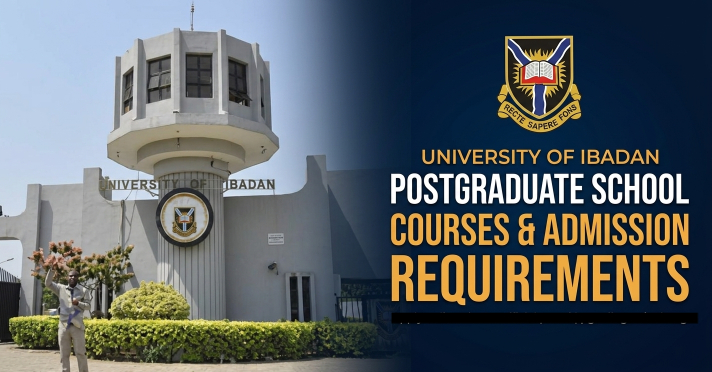
The University of Ibadan (UI), Nigeria’s premier and oldest university, runs one of the most competitive postgraduate admission processes in the country through its Postgraduate College, and prospective candidates searching for University of Ibadan postgraduate courses and admission requirements for the 2026/2027 session need accurate, current information before they commit an application fee. Candidates seeking entry into Postgraduate Diploma (PGD), Master’s (academic or professional), M.Phil, or PhD programmes must satisfy specific thresholds set by the University Senate, covering first-degree classification, O’Level credits, referee letters, and, for research degrees, a viable research proposal, before the Faculty Postgraduate Committee will even consider an application.
This guide breaks down UI’s official general admission requirements, the specific entry criteria for each degree level, a full faculty-by-faculty list of where University of Ibadan postgraduate courses are domiciled, the exact application steps on the Postgraduate College portal, and a realistic postgraduate fee outlook for 2026/2027. You will also find guidance on required documents, how to avoid admission scams, and answers to the questions UI postgraduate applicants ask most often, so read through carefully before you start your application.
About University of Ibadan’s Postgraduate Programs
Founded in 1948 as University College, Ibadan, the University of Ibadan became Nigeria’s first degree-awarding institution and remains its most internationally recognized university for postgraduate research. The Postgraduate College coordinates admissions, registration, and research standards across every faculty, institute, and specialized centre at UI, and admission is made by the Postgraduate College strictly on the recommendation of the appropriate Faculty Postgraduate Committee, there is no self-service admission at UI regardless of how strong an applicant’s credentials appear.
University of Ibadan postgraduate courses attract candidates from across Nigeria and internationally because of the university’s research infrastructure, depth of supervisory expertise, and global recognition of its degrees. Because faculties evaluate applicants competitively against one another in the same field rather than against a fixed pass mark, understanding both the general Postgraduate College rules and your specific department’s requirements before applying materially improves your chances of admission.
General Admission Requirements & Eligibility Criteria
Before applying for any University of Ibadan postgraduate course, every candidate must satisfy the following baseline requirements set by the Senate and the Postgraduate College:
- First degree or HND: candidates for admission to higher degree programmes shall normally be graduates of the University of Ibadan or other universities/institutions recognized by the Senate, holding a degree or Higher National Diploma in a relevant discipline; where a candidate’s first qualification is not strictly in the area of admission, remedial courses may be prescribed
- O’Level credit requirement: five O’Level credit passes at ONE sitting, or six O’Level credits at TWO sittings, including English Language and the subject areas relevant to the discipline, plus Mathematics for all science-based disciplines, Educational Management, and Economics, and at least a pass in Mathematics for other Social Science courses (NCE holders may alternatively present credit or merit passes in WASC or TC II obtained between 1967 and 1981)
- English proficiency test: Master’s and PGD applicants are required to sit for a test of proficiency in English Language and obtain a mark of at least 40% before their application can be considered
- Three e-letters of recommendation: submitted electronically by referees through the application portal; the referee report forms are part of the online application itself
- Official transcripts: mailed directly from the applicant’s previous institution to the Deputy Registrar/Admissions Officer, Postgraduate College; applicants should also upload an unofficial or student copy for temporary reference to avoid delays
- NYSC clearance: Nigerian citizens must hold a valid NYSC Discharge Certificate, Exemption Certificate, or Exclusion Certificate
Candidates may apply to only one department or programme per application cycle, and admission is offered on a full-time, part-time, or occasional-student basis. Full-time admission is reserved for candidates who are not in employment or who have been formally released by their employer to study full-time; candidates found to have made a false declaration on this point are asked to withdraw from the university. Part-time admission is generally open to academic staff of the university or candidates who can show that adequate facilities exist for part-time study.
List of Postgraduate Courses by Faculty
University of Ibadan postgraduate courses are offered across the following faculties, colleges, and specialized institutes and centres. Because the Postgraduate College updates its full prospectus every session, the specific specializations available under each department can shift; treat the list below as a guide to where your area of interest sits, and confirm the exact programme title with the relevant faculty before applying.
College of Medicine
- Basic Medical Sciences — M.Sc./Ph.D. in Anatomy, Physiology, Biochemistry, Pharmacology and Therapeutics, and related pre-clinical sciences
- Clinical Sciences — M.Sc./Ph.D./clinical fellowships across internal medicine, surgery, obstetrics and gynaecology, paediatrics, and psychiatry
- Public Health — MPH, M.Sc., Ph.D. in Epidemiology, Environmental Health, Health Policy and Management, Health Promotion and Education
- Dentistry — postgraduate clinical and research programmes in oral and maxillofacial disciplines
- Nursing — M.Sc./Ph.D. in Nursing Science
- Institute of Child Health — postgraduate programmes in paediatric and child health research
- Centre for Child and Adolescent Mental Health — specialized postgraduate training in child and adolescent psychiatry
Faculty of Pharmacy
- Postgraduate programmes in Pharmaceutical Chemistry, Pharmacology, Pharmaceutics, Clinical Pharmacy, and Pharmacognosy
Faculty of Veterinary Medicine
- M.Sc./Ph.D. programmes across veterinary clinical and pre-clinical sciences
Faculty of Science
- Computing — PGD, M.Sc., M.Phil., Ph.D. in Computer Science
- Chemistry — M.Sc., Ph.D. in Analytical, Organic, Inorganic, Physical, and Industrial Chemistry
- Physics — M.Sc., Ph.D. in Theoretical Physics, Geophysics, Electronics, Radiation Physics
- Mathematics — M.Sc., Ph.D. in Pure and Applied Mathematics
- Statistics — PGD, M.Sc., Ph.D. in Applied Statistics and Biostatistics
- Zoology and Botany — M.Sc., Ph.D. in Environmental Biology, Parasitology, Plant Pathology
Faculty of Technology
- Civil Engineering, Mechanical Engineering, Electrical and Electronic Engineering, Agricultural and Environmental Engineering, and Industrial and Production Engineering — all offering M.Sc./Ph.D. tracks with faculty-specific specializations
The Social Sciences
- Economics — M.Sc., M.Phil., Ph.D. in Monetary Economics, Development Economics, International Economics
- Sociology — M.Sc., Ph.D. in Industrial Sociology, Demography, Criminology
- Political Science — M.Sc., Ph.D. in Political Theory, International Relations, Public Administration
- Psychology — M.Sc., Ph.D. in Clinical Psychology, Industrial/Organizational Psychology
- Geography — M.Sc., Ph.D. in Geographic Information Systems (GIS), Climatology, Urban Planning
Economics and Management Sciences / School of Business
- Postgraduate programmes including the MBA and other professional and academic Master’s degrees in management-related disciplines
Faculty of Arts
- English — M.A., M.Phil., Ph.D. in Literature in English, English Language
- History — M.A., M.Phil., Ph.D. in African History, Economic History, International Studies
- Linguistics and African Languages — M.A., Ph.D. in Linguistics, Yoruba Studies
- Theatre Arts — M.A., Ph.D. in Media Arts, Directing, Dramatic Theory
- Philosophy — M.A., M.Phil., Ph.D. in Ethics, Epistemology, African Philosophy
- Religious Studies — M.A., Ph.D. in Comparative Religion, Christian Studies, Islamic Studies
- Institute of African Studies — interdisciplinary postgraduate research in African Studies
Faculty of Education
- Guidance and Counselling — M.Ed., Ph.D.
- Educational Management — M.Ed., Ph.D. in Educational Planning, School Administration
- Teacher Education — M.Ed., Ph.D. in Science Education, Language Education, Curriculum Development
- Special Education — M.Ed., Ph.D.
- Adult Education — M.Ed., Ph.D. in Community Development, Literacy Education
- Institute of Education — additional research-focused postgraduate education programmes
Faculty of Law
- Master of Laws (LL.M.), M.Phil. in Law, Ph.D. in Law
Faculty of Agriculture and Forestry / Renewable Natural Resources
- Agricultural Economics — M.Sc., Ph.D.
- Agronomy — M.Sc., Ph.D. in Soil Science, Crop Science
- Animal Science — M.Sc., Ph.D. in Animal Breeding, Nutrition
- Forestry Resources Management — M.Sc., Ph.D.
- Wildlife and Ecotourism Management — M.Sc., Ph.D.
Faculty of Environmental Design and Management
- Postgraduate programmes in Architecture, Urban and Regional Planning, Estate Management, and related built-environment disciplines
Other Institutes and Centres
- Africa Regional Centre for Information Science — postgraduate training in library and information science
- Centre for Entrepreneurship and Innovation, Centre for Petroleum, Energy Economics and Law, Centre for Sustainable Development, and Institute for Peace and Strategic Studies — specialized professional postgraduate programmes
- Distance Learning Centre (DLC) — select postgraduate-level programmes delivered in flexible mode
- Multidisciplinary Studies — cross-faculty postgraduate research tracks
UNILORIN Postgraduate Courses and Admission Requirements for 2026/2027 Session
Specific Degree Requirements: PGD, Master’s, M.Phil., and Ph.D.
University of Ibadan postgraduate courses and admission requirements vary depending on the target degree qualification, though every applicant must also clear the general O’Level and English proficiency thresholds described above.
1. Postgraduate Diploma (PGD)
- Who it’s for: Candidates seeking to switch fields, or to upgrade a Third Class degree or HND result into a track that can lead to Master’s admission later
- Academic requirement: A Bachelor’s degree with a Pass or Third Class grade, or an HND with a minimum of Lower Credit, from a recognized institution
- Note: A Third Class degree does not qualify a candidate for direct Master’s admission at UI; a PGD completed with strong grades is the standard route back into eligibility
2. Professional Master’s Degrees (e.g., MBA, MPH, MPM)
- Who it’s for: Working professionals seeking career-focused postgraduate qualification
- Academic requirement: A minimum of Second Class Lower degree, or a PGD with an acceptable credit grade; relevant work experience is often an advantage
- Application fee note: Professional programmes carry a higher application form cost than academic programmes
3. Academic Master’s Degrees (M.A., M.Sc., M.Ed., M.P.A.)
- Who it’s for: Candidates intending to pursue research or progress into an M.Phil/PhD track
- Academic requirement: A Bachelor’s degree from UI or a recognized university with at least a Second Class Lower Division; some highly competitive departments — particularly in Medicine, Law, and professional faculties — may set the bar at Second Class Upper or effectively screen out weaker Second Class Lower applicants during the competitive review
4. Master of Philosophy (M.Phil.) and Doctor of Philosophy (PhD)
- Who it’s for: Candidates for the M.Phil and PhD are admitted, in the first instance, to the Master’s Degree Programme
- Direct entry exception: Candidates who, in addition to a good first degree, already hold an acceptable postgraduate degree may be considered for direct admission to the M.Phil or PhD programme, on the recommendation of the appropriate Faculty Postgraduate Committee
- Provisional route: Where a firm recommendation for direct PhD admission cannot be made, a Faculty may recommend provisional admission into the M.Phil/PhD programme, pending an assessment carried out by a Faculty-appointed panel no later than the end of the candidate’s first semester
- Research proposal: PhD and research-based M.Phil applicants must present a research proposal, and contacting a prospective supervisor in the relevant research area before applying is strongly advisable, though not formally required
Step-by-Step Application Guide & Portal Navigation
Applying for University of Ibadan postgraduate courses requires navigating the official Postgraduate College portal. Follow these steps in order to complete your registration accurately:
- Visit the official portal — go to pgcollege.ui.edu.ng and locate the “Apply Now” link for the current session.
- Create your applicant profile — register with a valid, personal email address and an active telephone number to generate your application account.
- Generate your invoice and pay the application fee — the application form currently costs ₦20,000 for academic programmes and ₦25,000 for professional programmes; Master’s and PGD applicants pay an additional ₦5,000 for the English proficiency test. Pay online via the portal’s e-channels, or take the generated payment advice to any bank.
- Complete the online application form — log back in with your application credentials and fill in your bio-data, academic history, programme selection, and (for research degrees) your research proposal and statement of purpose.
- Upload your credentials — scan and upload your O’Level result, degree certificate(s) or HND, NYSC discharge/exemption certificate, birth certificate, and passport photograph.
- Submit your three referees — enter the names and email addresses of three academic referees; the portal automatically sends each referee a confidential report form to complete online.
- Arrange your official transcript — request your previous institution to mail your official transcript directly to the Deputy Registrar/Admissions Officer, Postgraduate College, University of Ibadan, well ahead of the deadline, since incomplete transcripts are a common cause of processing delays.
- Monitor your application — check your registered email and the portal dashboard regularly for updates on referee submissions, transcript receipt, and screening or interview invitations.
- Submit before the closing date — cross-check every entry for accuracy, submit the completed application, and print your confirmation slip and referee status page for your records.
KWASU Postgraduate Courses and Admission Requirements for 2026/2027 Session
Postgraduate Fee Structure & Registration Costs
The University of Ibadan Postgraduate College’s fee structure varies by programme level, faculty (laboratory-based programmes cost more than non-laboratory ones), and whether you are a fresh or returning student. Based on the College’s confirmed application fee schedule and the most consistently reported tuition and levy figures across previous sessions, postgraduate applicants for 2026/2027 should budget roughly as follows:
| Programme Level | Fresh Student (Session) | Returning Student (Session) |
|---|---|---|
| Postgraduate Diploma | ₦75,000 – ₦90,000 | ₦50,000 – ₦70,000 |
| Master’s — Arts, Social Sciences, Education, Law | ₦120,000 – ₦170,000 | ₦75,000 – ₦100,000 |
| Master’s — Science, Technology, Medicine | ₦150,000 – ₦200,000 | ₦100,000 – ₦150,000 |
| PhD — all disciplines | ₦150,000 – ₦200,000 | ₦100,000 – ₦150,000 |
| Professional Master’s (e.g., MBA) | ₦250,000 – ₦500,000 | ₦200,000 – ₦400,000 |
In addition to session fees, every fresh postgraduate student pays a one-time, non-refundable PG Acceptance Fee (in the region of ₦30,000) after receiving an offer of admission, on top of the application form fee described in the payment guide above (₦20,000 academic / ₦25,000 professional, plus ₦5,000 for the English proficiency test where applicable).
⚠️ Disclaimer: The application form fees (₦20,000 academic, ₦25,000 professional, plus the ₦5,000 English proficiency test) are confirmed directly from the Postgraduate College’s official admissions guide. The session-by-session tuition and acceptance fee ranges in the table above are estimates compiled from the most consistently reported figures across previous sessions, as University of Ibadan management has not published a single unified fee circular covering every faculty for the 2026/2027 session at the time of writing. Fees also vary by specific department and laboratory requirements. Please confirm the exact, current amount for your programme via the Postgraduate College’s official Fee Checker at pgcollege.ui.edu.ng before making any payment.
Important Application Documents & Transcript Guidelines
A major reason candidate applications are delayed or rejected at the University of Ibadan is incomplete document submission or missing academic transcripts. Prepare the following before your application deadline:
- Official academic transcripts — forwarded directly from your graduating institution to the Deputy Registrar/Admissions Officer, Postgraduate College, University of Ibadan; applications will not proceed to final selection without official transcript receipt
- Certificates and statement of results — clear scans of your original Bachelor’s degree or HND certificate
- O’Level result verification — WAEC/NECO scratch card details or original certificates verifying your credit passes
- Three academic referee reports — from professors or senior lecturers familiar with your academic work, submitted electronically through the portal
- Research proposal or concept note — mandatory for M.Phil and PhD applicants, outlining your proposed research title, background, methodology, and objectives
Scam Prevention & Official Verification Tips
Given the high demand for University of Ibadan postgraduate courses, fraudulent agents frequently attempt to impersonate university officials. Protect your application with these precautions:
- Complete all payments and form submissions strictly via pgcollege.ui.edu.ng, never transfer money to a private individual’s bank account or a third-party “admission agent”
- Verify that official correspondence from the Postgraduate College arrives via the portal or an address ending in @ui.edu.ng or @pgcollege.ui.edu.ng
- Remember that admission into UI is strictly merit-based, decided through competitive review by the Faculty Postgraduate Committee — disregard anyone promising “guaranteed admission” for an extra cash payment
- Keep both electronic and physical copies of every Remita receipt, application confirmation slip, and bank payment invoice until your admission is fully confirmed
FUTA Postgraduate Courses and Admission Requirements for 2026/2027 Session
Frequently Asked Questions
What is the application fee for University of Ibadan postgraduate courses? The application form currently costs ₦20,000 for academic programmes and ₦25,000 for professional programmes, with an additional ₦5,000 English proficiency test fee for Master’s and PGD applicants, as confirmed on the official Postgraduate College guide.
Can I apply for a UI Master’s programme with a Third Class degree? No, a Third Class degree does not qualify a candidate for direct admission into an academic Master’s programme at UI. The standard route is to complete a Postgraduate Diploma first and progress to a Master’s programme in a later session with strong PGD grades.
Does the University of Ibadan accept HND holders for postgraduate courses? Yes, HND holders from recognized polytechnics are eligible to apply for Postgraduate Diploma programmes in relevant disciplines, and can progress toward Master’s admission after successfully completing the PGD.
Is the NYSC certificate compulsory for UI postgraduate admission? Yes, Nigerian candidates must submit a valid NYSC Discharge Certificate, Exemption Certificate, or Exclusion Certificate as part of their application documents.
Can I get admitted directly into a UI PhD programme without an M.Phil? Only if, in addition to a good first degree, you already hold an acceptable postgraduate degree recognized by the Faculty Postgraduate Committee; otherwise, candidates for the PhD are admitted first into a Master’s programme, with a possible provisional M.Phil/PhD route subject to a first-semester assessment.
Conclusion & Next Steps
Understanding the full picture of University of Ibadan postgraduate courses and admission requirements, the general O’Level and referee criteria, the specific thresholds for PGD, Master’s, M.Phil, and PhD, and the realistic fee outlook for 2026/2027, puts you in a far stronger position to apply successfully at Nigeria’s premier university. Arrange your transcripts and referees early, verify your specific department’s requirements against the current Postgraduate College prospectus, and pay only through the official pgcollege.ui.edu.ng portal.
Bookmark MasterPG.com.ng and check back for updates as the University of Ibadan releases its full 2026/2027 postgraduate admission timetable and fee schedule. For details on other institutions’ postgraduate school fees and other useful information see our companion guides on MasterPG.com.ng.

Asuku Abdulmalik is an education content writer and the founder of MasterPG, a Nigerian postgraduate information platform focused on postgraduate admissions and school fees. With a background in researching and writing educational content, Asuku is passionate about making postgraduate information easier for students and prospective applicants to find and understand. Through MasterPG, he covers admission requirements, application forms, deadlines, admission lists, school fees, and practical guides for postgraduate students across Nigerian universities. He is committed to keeping MasterPG’s content clear, accurate, and regularly updated, while encouraging readers to verify important details with the relevant institution’s official sources before making any decisions.
Founder & Education Content Writer, MasterPG
Your Guide to Postgraduate Studies in Nigeria.